Eigen-nonlinear least square fitting

c++ 版本的 polyfit 和 numpy 同样的算法 Levenberg-Marquardt Optimization

折腾了 2 天,找到了一个讲的比较细致的文章,总算把问题解决了。

下面是参考原文:

ref. part1
ref. part2

The Levenberg-Marquardt curve-fitting method is actually a combination of two minimization methods: the gradient descent method and the Gauss-Newton method.

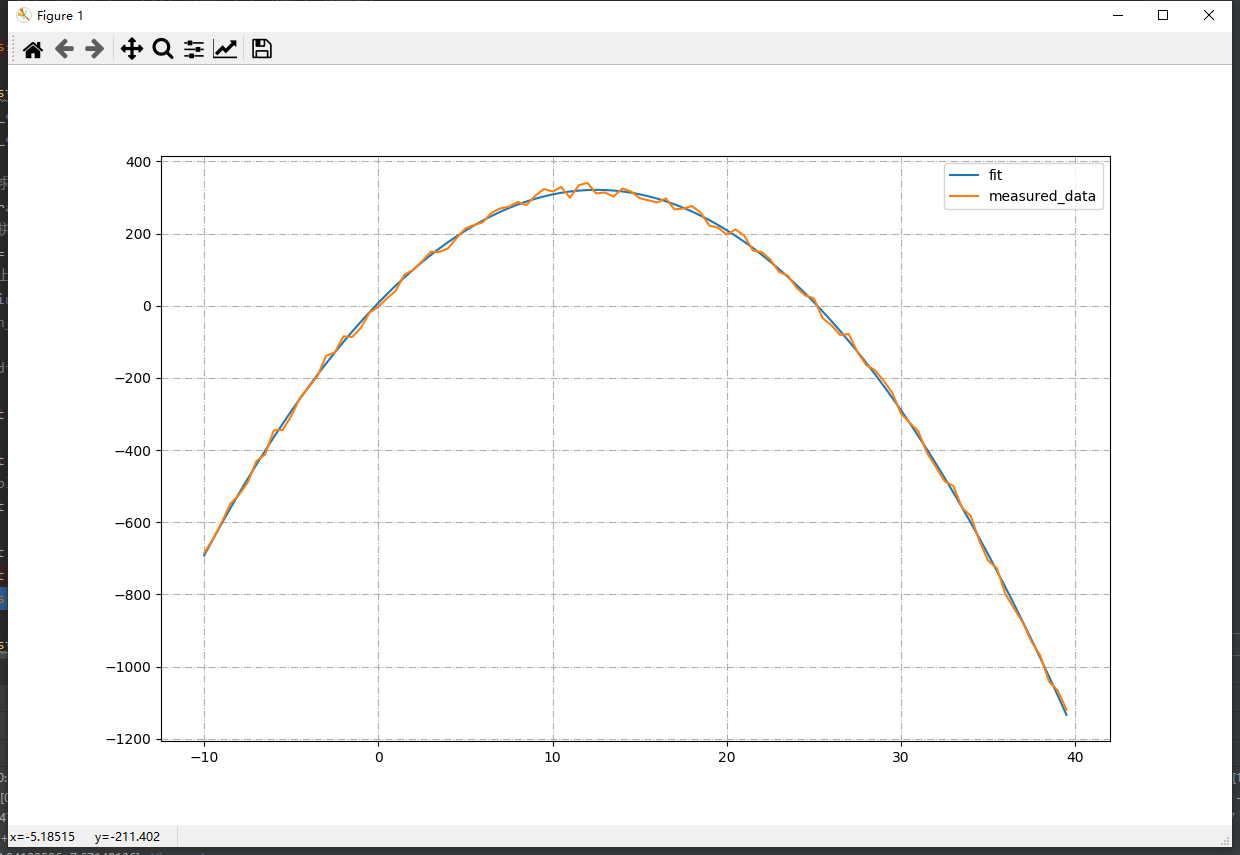
fit 是拟合后的数据,measured 是原始数据
20200603_102846.png

Eigen’s non-linear optimization module

速度巨慢

//
// PolyfitEigen.hpp
// Polyfit
//
// Created by Patrick Löber on 23.11.18.
// Copyright © 2018 Patrick Loeber. All rights reserved.
//
// Use the Eigen library for fitting: http://eigen.tuxfamily.org
// See https://eigen.tuxfamily.org/dox/group__TutorialLinearAlgebra.html for different methods

#include <Eigen/Dense>

template<typename T>
std::vector<T> polyfit_Eigen(const std::vector<T> &xValues, const std::vector<T> &yValues, const int degree, const std::vector<T>& weights = std::vector<T>(), bool useJacobi = true)
{
using namespace Eigen;

bool useWeights = weights.size() > 0 && weights.size() == xValues.size();

int numCoefficients = degree + 1;
size_t nCount = xValues.size();

MatrixXf X(nCount, numCoefficients);
MatrixXf Y(nCount, 1);

// fill Y matrix
for (size_t i = 0; i < nCount; i++)
{
if (useWeights)
Y(i, 0) = yValues[i] * weights[i];
else
Y(i, 0) = yValues[i];
}

// fill X matrix (Vandermonde matrix)
for (size_t nRow = 0; nRow < nCount; nRow++)
{
T nVal = 1.0f;
for (int nCol = 0; nCol < numCoefficients; nCol++)
{
if (useWeights)
X(nRow, nCol) = nVal * weights[nRow];
else
X(nRow, nCol) = nVal;
nVal *= xValues[nRow];
}
}

VectorXf coefficients;
//雅可比方法(Jacobian method)
if (useJacobi)
coefficients = X.jacobiSvd(ComputeThinU | ComputeThinV).solve(Y);
else
coefficients = X.colPivHouseholderQr().solve(Y);

return std::vector<T>(coefficients.data(), coefficients.data() + numCoefficients);
}


/*
Calculates the value of a polynomial of degree n evaluated at x. The input
argument coefficients is a vector of length n+1 whose elements are the coefficients
in incremental powers of the polynomial to be evaluated.

param:
coefficients polynomial coefficients generated by polyfit() function
xValues x axis values

return:
Fitted Y values.
*/
template<typename T>
std::vector<T> polyval(const std::vector<T>& coefficients, const std::vector<T>& xValues)
{
size_t nCount = xValues.size();
size_t nDegree = coefficients.size();
std::vector<T> yValues(nCount);

for (size_t i = 0; i < nCount; i++)
{
T yVal = 0;
T xPowered = 1;
T xVal = xValues[i];
for (size_t j = 0; j < nDegree - 1; j++)
{
yVal += coefficients[j] * pow(xVal, nDegree - 1 - j);
}
yValues[i] = yVal + coefficients[nDegree-1];
}
return yValues;
}